If you have been using Claude Code, Codex, or other AI programming agents recently, you are probably familiar with how efficiently they can debug scripts, refactor functions, and run tests.
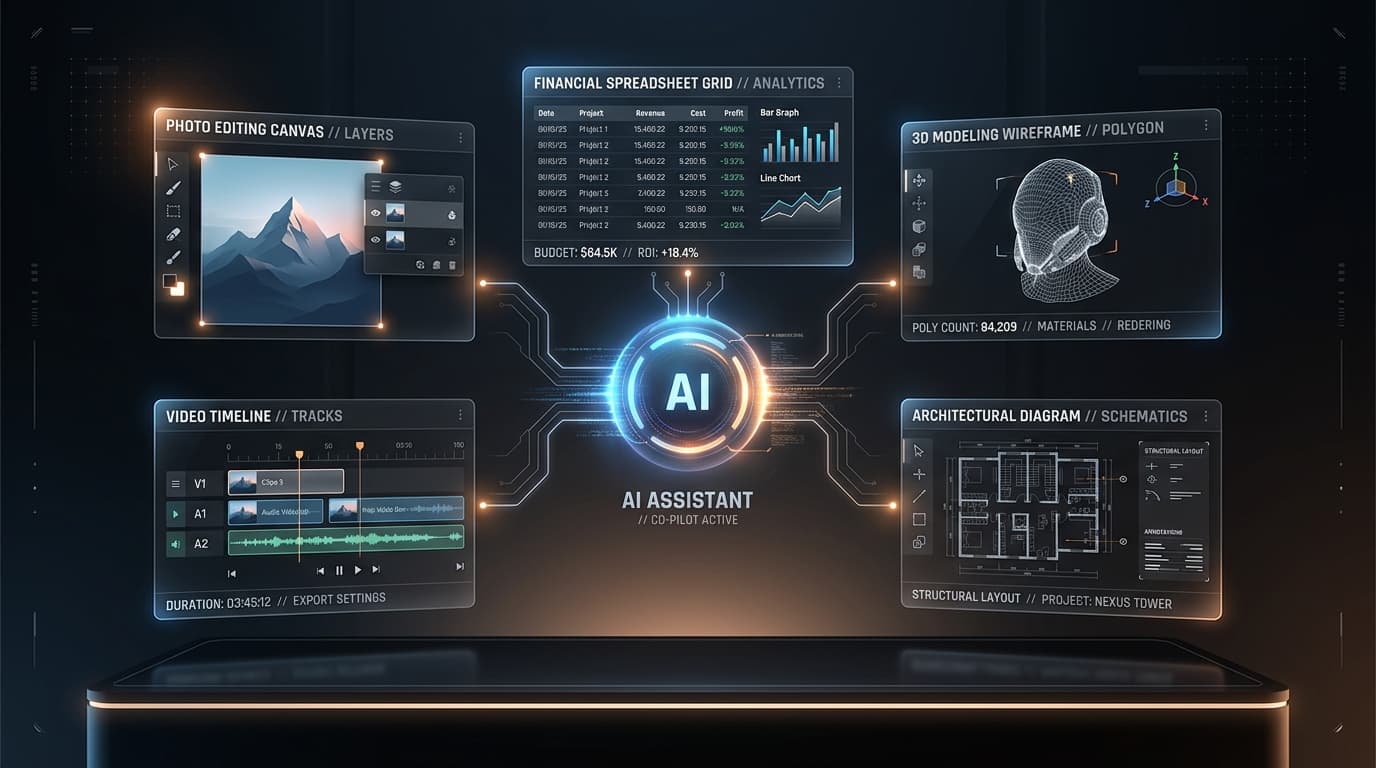
Yet a natural question quickly arises: if an AI agent can read and write code in our terminal, why can't it also retouch photos, format spreadsheets, slice video timelines, or render 3D scenes?
Traditionally, controlling desktop software with AI was notoriously fragile. You either relied on erratic computer vision to guess button coordinates on screen, or had to stitch together cumbersome macro scripts for each proprietary app.
A turning point arrived with two converging trends: the broad adoption of MCP (Model Context Protocol) as an open standard, and a surge of agent-native open-source creative applications.
Today, for almost every heavyweight software suite—from Adobe Creative Cloud and Microsoft Office to pro video editors and 3D suites—there is an open-source equivalent designed for AI agents to pilot directly.
This unlocks a unified, end-to-end creative loop:
Prompt → Design → Write → Crunch → Edit → Render → Ship
Here are 11 standout open-source repositories driving this transition.
1. Photoshop Alternative: PhotoCraft (Image Editing)
Daily photo editing tasks—trimming margins, swapping background colors, batch watermarking, or resizing canvas layers—are tedious when clicked manually with a mouse.
PhotoCraft is an open-source photo editor written from scratch in pure Rust, built specifically with a native MCP server.
- How agents use it: Instead of capturing the screen and guessing where to click, the agent communicates directly via memory and vector commands to spawn canvases, load layers, tweak filters, and export assets.
- Key advantage: Zero visual guesswork, instantaneous execution, and pixel-precise output.
🔗 GitHub: storytold/photocraft (63k+ Stars)
2. Word Alternative: WordCraft (Structured Documents & Formatting)
Pasting AI output into traditional word processors often creates a styling mess: inconsistent font hierarchies, broken table borders, and erratic pagination.
WordCraft is an open-source, clean-room reimplementation of Microsoft Word in pure Rust. It parses and generates native .docx files with a built-in MCP server.
- Use cases: Ask your agent to review contracts and highlight amendments directly, enforce corporate typography templates on draft memos, or compile research papers complete with tables of contents and page numbers.
- Key advantage: Reliable document generation that clients and colleagues can open seamlessly.
🔗 GitHub: storytold/wordcraft (13k+ Stars)
3. Excel Alternative: GridCraft (Spreadsheet Crunching)
While Python scripts can parse Excel sheets, configuring local runtime environments and dealing with complex formulas can be frustrating for non-developers and agents alike.
GridCraft is a lightweight, clean-room spreadsheet engine crafted for AI agents.
- How agents use it: Through standard MCP calls, your agent inspects cells, computes formulas across columns, balances multi-tab reconciliations, and outputs standard
.xlsxworkbooks. - Key advantage: Provides the agent with a dependable, structured calculation scratchpad during the financial modeling (Crunch) phase.
🔗 GitHub: storytold/gridcraft (5.2k+ Stars)
4. CapCut Alternative: Concat (Multi-Track Video Editing)
For content creators, the bulk of video production time is spent on mechanical prep: aligning voiceover tracks, trimming filler pauses, snapping captions, and applying simple transitions.
Concat is a free, cross-platform video editor featuring both an API and MCP connectivity.
- How agents use it: Hand your agent a directory of raw video clips and a voiceover script. Concat enables the agent to inspect waveforms, slice video tracks along spoken phrases, sync subtitles, and export ready-to-publish MP4 files.
- Key advantage: Turns video assembly from hours of manual scrubbing into script-driven automated compilation.
🔗 GitHub: jub0t/concat (6.9k+ Stars)
5. AutoCAD & SolidWorks Alternative: text-to-cad (Engineering 3D Models)
While generative image models can sketch artistic shapes, manufacturing and 3D printing require mathematically exact, millimeter-accurate solid geometries.
text-to-cad gives AI agents genuine engineering CAD capabilities.
- Output formats: It does not produce flat pixel artwork. Instead, it outputs industry-standard STEP (boundary representation solids), STL (triangulated mesh), and 3MF (additive manufacturing) files.
- Use cases: Prompt the agent: "Generate an electronics enclosure bracket with four M3 mounting holes and 2mm filleted corners." The resulting file is immediately ready for 3D printer slicers.
🔗 GitHub: earthtojake/text-to-cad (20k+ Stars)
6. Blender Integration: MCP for Blender (3D Animation & Rendering)
Blender is among the most versatile open-source 3D production suites, but its dense interface presents a steep learning curve.
MCP for Blender is a community-developed connector that links any modern LLM directly to Blender's internal API.
- Capabilities: Agents can arrange studio three-point lighting, import 3D assets, modify shader nodes, and trigger headless Python render scripts in the background.
- Workflow: Skip memorizing complex hotkey sequences. Tell your agent: "Set the primary light to a warm golden evening angle, apply a brushed aluminum material to the central product, and render a 4K preview frame."
🔗 GitHub: ahujasid/mcp-for-blender (30k+ Stars)
7. After Effects Alternative: HyperFrames (Code-to-Video Engine)
Traditional motion graphics rendering can push laptop cooling fans to their limits and hog gigabytes of disk cache. For product walkthroughs and kinetic typography, heavyweight project files are often overkill.
Built by the HeyGen team, HyperFrames embraces a web-native paradigm: write HTML and render crisp MP4 video.
- Why it fits agents: Large language models excel at composing HTML, CSS animations, and SVG markup. HyperFrames leverages these strengths, compiling web animations into fluid 60fps video files via a lightweight headless engine.
- Key advantage: Highly reusable templates that allow agents to generate hundreds of localized or personalized motion clips in minutes.
🔗 GitHub: heygen-com/hyperframes (64k+ Stars)
8. ElevenLabs Alternative: VoiceStudio (Local Voice Cloning)
Commercial voice cloning platforms deliver remarkable quality, but pay-per-minute meter pricing and sensitive audio uploads to cloud servers remain hurdles for many teams.
VoiceStudio is an open-source, fully offline audio workstation that serves as a local alternative to ElevenLabs.
- Core features: Voice cloning, voice persona design, video dubbing, precision speech-to-text transcription, and audiobook production across 646 languages.
- MCP support: Agents trigger voice generation tasks locally without internet access, eliminating ongoing API costs and preserving data privacy.
🔗 GitHub: debpalash/VoiceStudio (69k+ Stars)
9. Visio & Lucidchart Alternative: diagram-design (Editorial Visuals)
Standard AI-generated diagrams frequently fall into one of two extremes: awkward, generic flowchart shapes or cluttered diagrams with garish drop shadows.
diagram-design was built specifically for Claude Code, Cursor, Codex, and other AI coding environments, defining 44 high-fidelity diagram patterns.
- Design philosophy: Outputs self-contained HTML + SVG files stripped of unnecessary visual noise. The aesthetic mirrors clean, editorial figures found in technical journals and business white papers.
- Use cases: Architecture blueprints, sequence flows, customer funnels, and network topologies that look polished right out of the box.
🔗 GitHub: cathrynlavery/diagram-design (56k+ Stars)
10. Browser Operator: Playwright MCP (Live Web Automation)
Local file operations only tell half the story. Practical workflows require interaction with the broader web: conducting live research, fetching dynamic documentation, testing deployed apps, or publishing finished deliverables.
Microsoft's official Playwright MCP server connects agents directly to real browser sessions.
- Capabilities: Far beyond static web scrapers, Playwright MCP allows AI to click dynamic JavaScript elements, solve authentication flows, capture viewport screenshots, and inspect network traffic.
- Role in the loop: Represents the vital final link—shipping and verifying content online.
🔗 GitHub: microsoft/playwright-mcp (38k+ Stars)
11. Universal Bridge: CLI-Anything (Agentifying Any Desktop App)
What if you rely on a niche software tool that lacks an official MCP server or modern API?
Developed by the HKU Data Intelligence Lab (HKUDS), CLI-Anything tackles this challenge head-on by making existing command-line and desktop software agent-native.
- Mechanism: It inspects target software options, arguments, and documentation to automatically generate an agent-ready command-line interface.
- Ecosystem: Its companion CLI-Hub hosts community-packaged modules, allowing agents to expand their software toolkit on demand.
🔗 GitHub: HKUDS/CLI-Anything (53k+ Stars)
The Big Picture: Redefining the Digital Desk
Looking at these 11 tools reveals an unmistakable trend:
AI is graduating from a passive conversational assistant into an active operating-system coordinator.
In conventional product workflows, building a prototype required jumping between separate tools: Figma for mockups, Word for copy, Excel for numbers, After Effects for motion, and an IDE for code.
With MCP standardizing the control plane, agents are breaking down these software silos. For solo builders and independent creators, mastering every sub-menu is no longer required. Clear objectives combined with agent-native open-source tools can carry an idea from initial concept to completed deliverable.
All repositories featured above are open source and support self-hosting. SeekLumen will continue tracking and testing emerging agent-native desktop tools as the MCP ecosystem evolves.